Thursday, March 30, 2006

Power Within Our Groups

Ricia over at Impetus Java House has an ongoing series that she calls About Power. Recently, she decided to open the series up for contributions from other writers, and she asked me to submit something. I have done so: "Power Within Our Groups."

Here are the first couple of paragraphs as a teaser to get you over to the Java House to read the rest!

I've always sort of pictured it as something as big as the sky that gets squeezed down to a point and then spills from that point like vomit, to pollute everything it touches.

I'm talking about power and how it messes with our social change groups from within, makes them less functional and less pleasant, makes them exclude or silence or shatter to bits. The origins of that are society-wide, so we can't stop it completely -- we can never create complete health in one microcosm while our society remains so sick. But we can take responsibility for knowing what's going on, for expecting it, and for developing skills to navigate it and nudge the spaces we co-create in more liberatory and effective directions. We need to see the nurturing of such awareness and skills, in ourselves and others, not as something to worry about when we have time and energy left over at the end of the day, not as an add-on to the "real work," but as a core, fundamental task in our quests for radical social change.

Read more!


Go check it out!

Wednesday, March 29, 2006

Sudbury Star: "Coloured People"

I spotted an interesting article at the top of the front page of today's Sudbury Star -- interesting because it talks about something that the dominant media usually avoids in this country, which is the racist nature of Canada's legal system, and also because there are some important ways in which it does so quite poorly. Here is the link to the article in the Star's online version, but they do not archive content online so it will expire quickly.

The title of the article is very direct: "Colour of justice in Canada is white, panel told."

It begins:

The criminal justice system is failing aboriginal people in Canada, a group of professionals who work in the system said Tuesday.


That's a decent lead. It is perhaps a little euphemistic, but it is still a fairly strong statement. The article then spends a few paragraphs explaining that this was an event by the local university's Native Studies Department, and involved professionals from the criminal justice system.

Then it continues:

Defence lawyer Robert Topp read an excerpt from The Colour of Justice by David Tanovich, a new book that argues the colour of justice in Canada is white.


Sounds like it might be an interesting book. Again, the article avoids using the dread "r" word, and makes sure that it attributes the statement as opinion rather than letting it stand on its own as a fact, but it is still quite blunt.

Topp agreed and said there is no “true justice” for coloured people in our country.


Uhhhhh...excuse me? "Coloured people"? Did I actually just read that?

Yes. Yes, I did.

The expression "coloured people" has been regarded as racist and generally not used by racialized people in North America for decades. The journalist is paraphrasing Topp, and I would bet he used the expression "people of colour." Though there are individuals who object to that expression as well, it is widely accepted among anti-racist activists and writers in North America. It may seem like a small, semantic difference, but the significance is the difference between a name forced on racialized people by white people and white power structures, versus one that originated from leaders and activists and writers in racialized communities themselves. Though it does not explicitly recognize the immense diversity that it encompasses, "people of colour" does indirectly make the point that it exists because of a (differentially) shared experience of racism.

All people, but especially people and institutions that make their living based on the use of words and the conveyance of information, have a responsibility to understand that words have power, and that words have histories. While it is good that racism in the criminal justice system is getting front page treatment (even if the article never uses the word), what does it say about the Sudbury Star that it, as an institution, is unaware of this semantically small but politically very significant difference?

Of course the added complication to that is that the term "people of colour" as I have learned to understand it is not generally used to include the people of the indigenous nations of North America. Though both groups experience racism and suffer at the hands of white supremacy, it is my understanding that indigenous groups have been quite insistent historically on a separate label because being included under "people of colour" would obscure their particular relationship to the land and to the colonizing and genocidal forces that have brought the Canadian settler state into existence. The article seems to treat them as interchangeable.

And on a related note, I suppose it would be useful context for non-local readers that there are more people of indigenous nations in the Sudbury Star's readership area by far than racialized people of other backgrounds, so a primary focus on their issues is understandable. Still, there are small communities of colour in Sudbury as well, and even if theire weren't the issue still impacts people of colour in the rest of Canada. If this author and this expert were connecting the issues to the experiences of people of colour as well, as they seem to have been, surely it would have been appropriate to mention that connection, even if only briefly, in the article.

The article continues:

If Canada is ever to arrive at “true justice,” then it has to abandon the “insane notion” that white people have all the answers, said Topp.

“It’s time, in my ... opinion, that matters of legal questions be returned to the aboriginal community,” said Topp.


Again, some solid stuff. I think to really convey to people what it might mean to return control over legal matters to indigenous nations would require a lot of unpacking -- true self-determination requires changes in this area that are a lot more radical than the very limited kinds of devolution of a limited subset of responsibilities that is currently on the radar for the Canadian state. But, still, this is only a newspaper article.

Next:

Assistant Crown attorney Philip Zylberberg shared his experience of travelling to the remote northern community of Kashechewan to appear in court. While “trying to do what’s fair,” there was something bizarre about the situation, he said.

White people were being flown in to administer justice to the Cree. After court adjourned, planes were ready to take the lawyers and judge away.


Okay, sure, that's worth pointing out as a problem. It would be good to point out that five hundred years ago the Cree were perfectly able to handle their own legal issues, and that there is a whole bunch of history between then and now that has lead to white folk coming in by plane to dispense settler state "justice." Some mention of that history would probably provide useful context for readers. But even the basic idea that maybe it's not cool for this to be happening isn't one that would be universally understood by white readers, so pointing out that it is a problem is a useful thing.

And the rest of the article:

Liza Mosher, a native elder, walked into a woman’s federal penitentiary for the first time in the early 1970s.

“I was terrified to go into the women’s prison in Kingston,” she told the audience.

But what was more alarming was how the spirituality of the aboriginal women imprisoned there was violated.

Mosher said she heard their cry for help. Many of the aboriginal offenders were sexually abused and the confines of the prison offered no healing.

The women needed a healing lodge, a place to deal with their pain and “walk the good life.”

Corrections Canada later established a healing lodge at Maple Creek First Nation in Saskatchewan and subsequent jails such as the Sudbury District Jail have adopted similar aboriginal practices.

The Sudbury jail has incorporated a teepee and sweat lodge into the lives of aboriginal prisoners, thanks to the determination of its native liaison officer.

“I spent a couple of years putting people in jail and the last nine years getting them out,” said Vince Pawis.

Pawis worked as a police officer for a couple of years before working at the Sudbury jail. The aboriginal program has had a positive effect within the aboriginal prison community.

“They’ve changed their lives and walk in a different way,” said Pawis.

The aboriginal program has created a ripple effect across the province, acting as a model for other jails, said Pawis.

And so has Greater Sudbury Police’s Mkwa Opportunity Circle, said Pawis, a program spearheaded by Police Chief Ian Davidson, which works to improve the relationship between police and the aboriginal youth while encouraging them to pursue careers in policing.


A few more points: First, you'll notice it wasn't until half way through the article that someone identified as being Native themselves was given space to speak. And while it is good to talk about the history of denial of indigenous spiritualities in the prison system, and that change is happening, this whole last segment -- even as it quotes Native people -- undermines the initial strong words about a racist criminal justice system by making it all about indigenous people who have "changed their lives" (or that need to), thereby focusing attention on the victims to avoid talking about the power structure and people that are the problem, and being able to emphasize changes that have been made and give the impression, "Don't worry. We got it figured out. It'll be fixed in no time."

There is no use of statistical evidence to show that the assertions about a racist justice system at the top of the article are, in fact, more than a handful of professionals spouting off. This material is easy to find. There are lots of studies, including one by the Ontario provincial government in the early nineties, which demonstrate racially disparate (i.e. racist) outcomes at every stage of the criminal justice system. This absence, and the absence of any mention of the history of struggle by indigenous communities and communities of colour against racist policing and a racist judicial system, is a failure to adequately explain (and therefore to adequately support) the assertions by experts early in the article.

The article also fails to explain that while lack of control of legal mechanisms by First Nations on reserve and denial of indigenous spiritualities in prisons are two mechanisms by which the "colour of justice" is made "white," there are also lots of others. Even a vague sentence about how this permeates almost every function of the judicial system is not included.

In fact, though I still think it is good to have this issue make the front page, it is indicative of how the public consciousness is constructed as "white," and the privilege of that whiteness is completely naturalized, that the idea of a racist criminal justice system is news at all and that no statement is included acknowledging that this is really only news to white people.

Anyway, I have no snappy closing. I just wanted to make the point that it is good that this article was present, but that it was present in some pretty messed up ways.

Monday, March 27, 2006

LA Immigrant Rights March

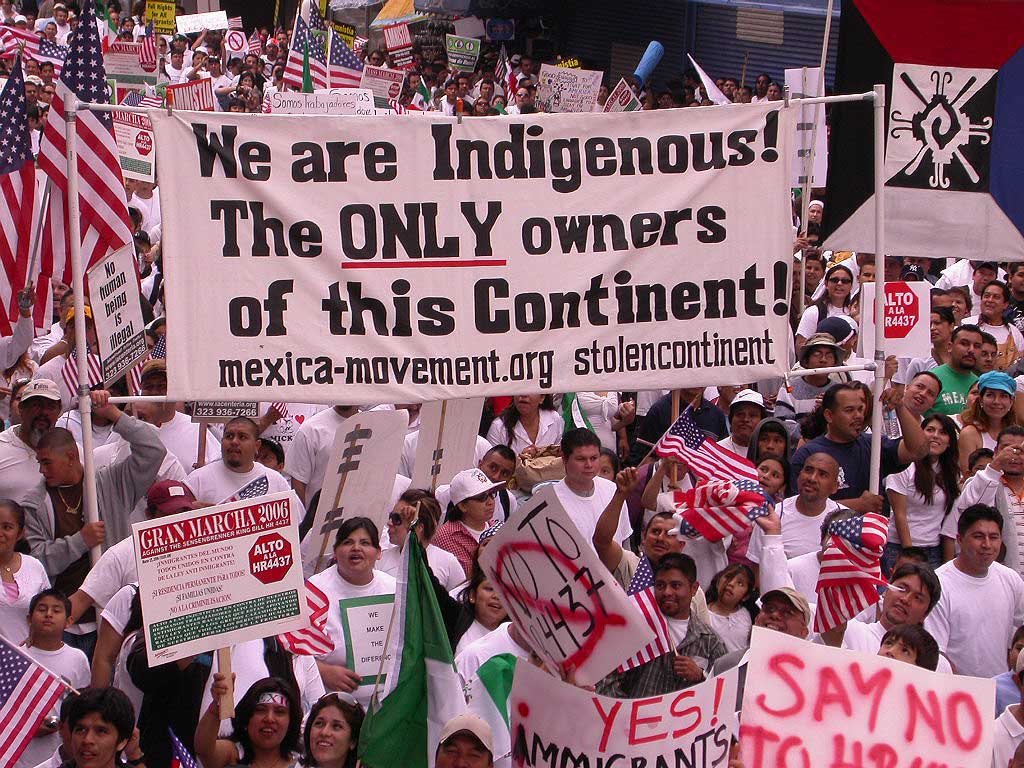
While living in Los Angeles, I attended a couple of anti-war marches on those periodic days of action that the U.S. anti-war movement has. I was disappointed that a city of 13 million people would only get a few thousand out to oppose the war. That's why it was very heartening to see photos like this and this -- there is a horrid anti-immigrant bill making its way through the U.S. Congress at the moment, and somewhere between half a million and a million people showed up in Los Angeles recently to oppose it. Here is a link to more photos and some reports of the action.

I especially like the message in this photo.

Friday, March 24, 2006

Feral Scholar » Gulf Coast Peace Train

To balance out the unfortunate revolutionary machismo in the report on the local Sudbury action I borrowed and pasted into my post yesterday, and because I encouraged people to support it even though it happened half a continent away from where I live, here is a report from Stan Goff on the Veterans and Survivors March along the Gulf Coast to New Orleans.

An excerpt:

And there was dancing. We danced down the Gulf Coast. Ask anyone who was there. We danced in Prichard. We danced along the highway during breaks when the Iraq vets would pull out their drums. We danced in a relief worker camp and in a soccer field. We danced down the streets of Slidell to drums, a tuba, and a tenor sax. We danced in Congo Square. We swayed and clapped to the sounds of church choirs.


Sounds like it was an amazing action.

Thursday, March 23, 2006

Sudbury Anti-Poverty Action Report

As posted earlier, the Hunger Clinic Organizing Committee in Sudbury, of which I am a part, held an action yesterday demanding that the province raise social assistance rates by 40% and reinstate the previous version of the Special Dietary Supplement. L and I attended the rally and food serving at the beginning. We lasted about 40 minutes -- it was cold, and the puppy that had been distracting L from how cold he was getting went home, so he demanded to head out as well and we did. Unfortunately, we did not get to participate in the little visit to the offices of the Ministry of Mines and Northern Development, whose Minister is our local MPP.

Here's an action report from the Tenant Action Group in Belleville, members of which came up to Sudbury and participated in the action:

Yesterday, members of Sudbury's Hunger Clinic Organizing Committee (HCOC) led a militant occupation of Liberal MPP Rick Bartolucci's Ministry offices in Sudbury. The entire office building was in "lock-down" mode as approximately 60 people occupied the seventh floor of Bartolucci's Ministry of Northern Development headquarters to give his government a mere taste of what awaits if today's provincial budget does not result in a 40% social assistance increase.

Ontario Common Front (OCF) comrades from Kingston and Guelph's Guelph Union of Tenants and Supporters, the Kitchener/Waterloo Youth Collective, the anarchist ROAD Collective, Peterborough Coalition Against Poverty and Belleville's Tenant Action Group showed solidarity by participating in yesterday's action. Members of Mine Mill/CAW Local 598 were also on hand to provide labour muscle.

Having made our point that the people can strike wherever and whenever we choose, our rowdy and spirited delegation left the Ministry offices promising to return in an escalated strategy of disruption if social assistance rates are not increased.

Anti-poverty groups from across Ontario were buoyed at the presence of poor people politicized for the first time and determined to carry the struggle forward, despite police over reaction but encouraged and humoured by the helplessness of the state. This action follows on the heels of Ontario Rental Housing Tribunal disruptions across the province (Toronto, Kitchener, Guelph and Peterborough) and other militant actions by Ontario Common Front groups in Kingston and Belleville.

Unless justice for poor people is orthcoming we will continue our fight to beat back the liberal attack!

Hostages Released!

According to the Globe & Mail, the surviving Christian Peacemaker Team hostages in Iraq -- including James Loney, whom I met a few times doing anti-war and anti-militarism stuff in Hamilton, Ontario -- have been released.

I'm not a religious man, but if I were, I would be thanking God right about now.

Wednesday, March 22, 2006

Anti-Patriarchal Men Unite!

Another great post from Darkdaughta. This one is called "Anti-patriarchal movement yet to find its stride...". She talks insightfully and compassionately about the ways in which patriarchy damages men, and relentlessy about the responsibilities that we (men) have for acting to undermine patriarchy.

The comment thread has some interesting stuff too. Here is my contribution to the discussion:

Amazing post, Darkdaughta. Like Hugo said, "powerful and compassionate."

I've been aware on a certain level that dealing with the ways in which patriarchy has damaged me is inseparable from whatever personal/political responsibilities I have towards people whose oppression gives me (damaging) privilege. But the masculine tendency that you mention to deny or downplay our own experiences of hurt -- to follow the path of that knight in Monty Python's Quest for the Holy Grail who insists "It's just a flesh wound!" no matter how many limbs have been hacked off -- tends to nudge me towards treating considerations of my responsibilities towards others as the "real" political work, but dealing with my own damage as somehow less real, less political, less important. And shameful to have to do, of course. And probably scarier, if I'm being honest with myself.

I know intellectually that really it is one integrated kind of work, not discrete "inside" and "outside" responsibilities, of course, but often enough that recognition of unity doesn't make the trip from my head to my gut. I think the radical compassion in your post has, at least for now, given me a jolt in the right direction. Thanks.

And now back to talking theory... ;)

At least on an intial read through, my biggest question about the post is around the idea of a movement, and what that might mean. I mean, I definitely agree that the idea of politicized pro-feminist men supporting each other and acting collectively to oppose patriarchy is a good one -- that isolation you talk about is very real, and I think it's important (though still scary...thank-you, masculinity!) to support each other instead of depending entirely on the feminist women in our lives.

But how would those needs and possible activities turn into a movement? Mostly when that word is used unadorned, people with politics that go beyond liberal in some sense tend to think of liberation movements -- people unified based on some shared experience of oppression who work together to oppose that oppression. Movements based on ideas of "worker" or "woman" or "queer" or whatever have all tended to replicate other oppressions within their own functioning, of course, so even that model isn't as simple as the more privileged proponents of each like to think. But negotiating that complexity is not the same as trying to create a movement that is centred on an identity that, while it may be damaging, is a source of privilege.

What would that look like? How would it function in ways that maintained accountability to women? How could we be sure it would not end up sucking energy from feminist spaces rather than supporting them, or making itself the centre of attention and talking when it should be listening, or keeping safely quiet when it should be raising a ruckus?

Answering those kinds of question is essential, as you say. And obviously I'm not asking you to answer them...like you say, we need to start figuring some of that stuff out for ourselves.

A few years ago I read a book by an academic whose name escapes me at the moment -- an Australian guy, I think -- who talked about some of the history of pro-feminist men's movements. He was very pessimistic about the possibility of such a thing being effective, based on the ways in which most attempts by men to do that sort of thing coming out of the second wave of feminist movement eventually degenerated into apolitical self-help groups, which can be helpful to individual men but are not a movement, or into entities that are actually passively or actively anti-feminist. His attempt at an answer was based on the idea that men coming together as men was not a good idea, but that men gathered as, say, workers or as gay should seek to form alliance with collectives of feminist women, and that in the context of that alliance (and as a condition for it) there might be the possibility of men working on their experience of patriarchy at an individual level and beginning to work to end it at a collective level. Not sure I entirely bought that...just judging by the tone, I'm not sure the guy who wrote it entirely bought it either...but he was at least taking a stab at figuring some of this stuff out. And, like you say, it is essential work to begin. The world needs it.

And, personally, I wouldn't mind having a well to draw from.


That last line is based on something she says in the original post:

This is not to say that individual men or small groups of men aren't trying for something different. But they function as independent misunderstood and oftimes harried cells with no massive anti-patriarchal resources collectively studied and shared so as to sharpen critiques of masculinity, maleness, gender, sex, sexuality, relationships to self and familiy and whatever else impacts on their lives.

They don't draw from a well in ways that even the youngest girl child may be able to at some point in her life at this herstorical moment in time.


Give it a read!

Tuesday, March 21, 2006

Review: Sisters or Strangers?

[Marlene Epp, Franca Iacovetta, Frances Swyripa, editors. Sisters or Strangers? Immigrant, Ethnic, and Racialized Women in Canadian History. Toronto: University of Toronto Press, 2004.]

After a stressful parenting day and some (admittedly therapeutic) collective vegetable chopping in preparation for tomorrow's action, with brain running at only about 20% and a glass of whiskey in hand, he will attempt to write...

Collections of academic essays are always difficult to review. Usually the theme uniting the works is fairly diffuse, with no clear narrative thread tying them all together, and you have to be an expert to really appreciate such a volume as a deliberate intervention with a particular agenda to shift or disturb an existing field of knowledge.

In addition, academic disciplines tend to have their own rules about constructing texts. These rules are often not particularly concerned with enhancing the experiences of the reader, and are rather focused on accruing legitimacy to the writer by transforming or presenting knowledge in ways that will meet with approval from fellow specialists. Certainly there are exceptions to this, but by the strange logic of academic professionalism, enchanting writing in spaces in which the discipline of the discipline is operating is often either a calculated risk by someone low in the hierarchy or an indulgence by someone with high status within the field.

Many of the books I review on this site I have read with a particular end in mind, and so I frequently review them in light of their usefulness towards accomplishing that end, as well as how I think other people interested in this general area might respond to the book.

And with all of that in mind...

This was an important book for me to read. It isn't one that provides me with much in the way of concrete information for a concrete chapter in the book I am attempting to write, however. There were perhaps three or four of the essays that will translate into small points scattered throughout what I'm writing. I can imagine making referece to the essay on the role of Methodist missionaries in colonialism in Upper Canada, the one about the radical consumer movement of the late '40s, the one that talks a lot about the role of separate educational institutions in a larger discussion of Japanese Canadians' resistance to racism in the early twentieth century, and the one that talks about Black immigrant nurses in Canada.

But the book was more important to me as a source of general context. My work is focusing on aspects of resistance that are most likely to include collective and public elements -- social movements -- but it is a serious mistake to treat that as the sum total of what "struggle" and "resistance" mean. The central identities for these essays were all women who were oppressed because of their skin colour or their ethnicity or their citizenship status or some combination of those things, and basic social history focusing on those identities is also inevitably history of resistance. In my work I may not have direct use for, for example, a history of intermarriage in Armenian Canadian and Armenian American communities in the twentieth century, but in learning about that I learned about the ways in which genocide and diaspora can impact a nation and can impact individuals even multiple generations later. And, however fascinating I found this essay, I probably will not have occasion to talk about the negotiations around food-related practices among newcomers to Canada, white anglo Canadians already living here, and the Canadian state in the middle of the twentieth century -- but dynamics of adaptation, cultural appropriation, state meddling in cultural practices, and the impact of the physical and social infrastructure that is inescapable in North America are important to have a clue about in doing the writing I'm doing.

This book was a slow read, and the unpleasant imprint of the demands of the academic discipline of history left its mark on at least some of the essays. But you will learn if you read it.

And you will also probably have moments of shaking your head and thinking, "Yep. This sure is Canadian." For me that moment came in the essay about the race riot in Linday, Ontario, in 1919. Yes, Lindsay, a town that even today has fewer than 20,000 inhabitants, had a race riot. The situation was complex, with important dynamics related to racist Canadian immigration law and gender within racialized communities and gender within white Canadian society and wife abuse and mental illness and white Canadian (notably including a few of the first-wave feminists in the town) racism, and the essay does a good job (as far as I can tell) in teasing out the nuance. But it ended up with several hundred white people destroying the handful of Chinese-owned businesses in the town.

The Candianness? Well, first of all there was the involvement of the hockey fans:

At 11 P.M., a tide of several hundred Lindsay hockey fans, rejoicing in victory over the rival Peterborough team, bolstered the angry crowd. Shouting racial taunts, five hundred men and boys shattered the windows of the Chuong Sun Laundry with a barrage of bricks, stones and ice. They demanded that Lee come out so the crowd could rough him up... When the rioters heard that Lee had escaped, about four hundred went home, satisfied that their mesage was heard. The remaining seventy-five to one hundred rioters avenged their loss by attacking two other Chinese businesses, starting with a cafe where Lee's co-workers from the laundry had taken refuge. The rioters smashed fixtures, looted, and threw Chinese personal possessions into the street. At daybreak Lindsay newspapers evoked images of war-torn Belgium to describe the property damage. ["The Tale of Lin Tee: Madness, Family Violence, and Lindsay's Anti-Chinese Riot of 1919" by Lisa R. Mar, pp. 108-109 in the above volume.]


The other particularly Canadian aspect was that the author went to Lindsay to investigate, and extensive interaction with current inhabitants of the town showed the complete erasure of the disgusting violence described above from the local historical memory.

[Edit: For a list of all book reviews on this site, click here.]

Saturday, March 18, 2006

Come To Sudbury Anti-Poverty Action!

If you are in Sudbury or can make it here on March 22, please consider participating in the following action that seeks an increase to the criminally low social assistance rates in Ontario.

RAISE SOCIAL ASSISTANCE RATES NOW!
Anti-Hunger/Anti-Poverty Rally and March


Wed. March 22
Feeder March 11:30am from the Samaritan Centre
Rally: 12 noon. Provincial Building (corner of Larch and Paris). Free Food.

It is time to show the Ontario Liberal government they cannot take food from poor families without facing popular unrest. We need an immediate raise in social assistance rates by 40% just to get back what they took from us since 1995. They recently slashed the Special Diet Supplement making it harder for people to get the money they need to survive.

Come out and participate in the rally and in a women and children led march highlighting the impact of poverty in the lives of women and children. The government must be told it cannot get away with starving people and the families on welfare or disability. It is time for action, its time to take our message to those who are continuing the Tory war on the poor.

HUNGER CLINIC ORGANIZING COMMITTEE

Supported by Mine Mill/CAW Local 598 and many others.
Bus tickets and child-care funding support available at the rally.
Contact: hcoc@riseup.net Website: http://scap.revolt.org/


Hope to see you there!

Friday, March 17, 2006

OPIRG Memories

The first social change organization I connected with back when I was a university student was the McMaster University chapter of the Ontario Public Interest Research Group. It is a student funded, student run group for promoting social change. The exact issues and kinds of action taken vary from campus to campus and year to year based on what students themselves want to do. It's a structure that has limitations, as every structure does, but its role as a provider of infrastructure to allow groups of students to pursue whatever issues happen to interest them has always struck me as a model with a lot to recommend it. (And for U.S.-base readers, I think the PIRGs in Canada tend to be less focused on lobbying and legislation and more focused on grassroots activism than the PIRGs in the U.S.)

I went on to do other kinds of political stuff with one of the staff there after I graduated, and he and I still keep in sporadic touch. (He's also a regular reader of this blog -- Hi Randy!) He asked me to write some brief reminiscences about my time involved with OPIRG McMaster for them to put up on their web site. The idea is partly to promote the organization, and partly to provide a broader picture of what social change can and does mean by getting former OPIRG activists to talk about their experiences. What I wrote is longer than he wants, so I may end up having to change it before it goes up on their site, but I thought I'd post this draft here...I haven't exactly been diligent about producing original writing for the ol' blog in the last week or two, and this was quite fun to write, so I thought I'd share it.

I first met OPIRG when OPIRG first returned to McMaster, and we got along famously from day one. My very first "activist" meeting of any kind was filled with tired, happy people overjoyed at just having won funding to bring OPIRG to campus and strategizing about what to do next. It was the end of my second year of a biochemistry co-op degree, and I had been doing some reading and thinking and decided I wanted to see what this whole social change thing was about. Somehow, a few meetings later, I was on the committee charged with hiring OPIRG McMaster's first staff over the coming summer.

At the beginning of the next school year, still very new and unsure of how I wanted to be involved, I signed my name to a list for the Waste Reduction Working Group. A few weeks went by. I dropped by the OPIRG office to see if maybe my name had somehow dropped off the list and I wasn't getting the emails that had surely been circulating about the meetings that had surely been held. It turned out that nothing at all had happened yet. By the time I left the office -- completely unsure about how introverted, neophyte me had been convinced that this was a good idea -- I had a list of contact information in my hand and had committed to doing what I could to make sure things got rolling. I was heavily involved in Waste Reduction for the next three years.

I also have very fond memories from that first autumn of the weekly Get Up, Stand Up! Film Festival -- every week I helped out with it; every week I was rewarded by some fascinating and new-to-me blast of information and ideas; and every week I had the pleasure of walking part of the way home beside someone a little older and a little more experienced, and getting to mutually process what we had just seen. I also plunged into the print resources that the OPIRG office provides, and in my two-year term on the Board of Directors took great delight in overseeing the spending of money to broaden and deepen the collection. I got involved in other working groups, in doing other tasks, and when I graduated and drifted from a geographical identity centred around "McMaster" to one grounded in "Hamilton," I stayed in touch.

University can be a time when some of us who didn't grow up facing them in our daily lives are first confronted by ideas and writing about the brutal realities of our society. These realities get named in lots of partial ways, but they add up to interlocking hierarchies of privilege and oppression based on class, race, gender, sexuality, nationality, ability, and more, in a political economy that depends on death and suffering not only to enrich the most powerful elites but to reward those of us who have more mundane forms of privilege as well. For me, OPIRG provided some tools to start learning about bits and pieces of that, and opportunities to start taking action around those corners of the beast that I was starting to see. OPIRG is just one organization, just one set of tools, and many folk might find other choices that would better suit their consciousness, their experiences of oppression, their desires to act. For me, however, OPIRG McMaster was an important ingredient in kicking off an ongoing journey of consciousness and action.

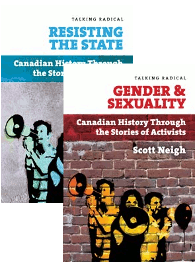
That journey has taken me lots of other places, of course, and all of them have shaped me further, but having OPIRG available when I was in a crucial stage of questioning and searching was an important catalyst. I'm still not sure how well I understand much of anything, and make no great claims for the decisions I make about acting in the world, but my journey of political consciousness informs how I function as a parent, as a partner, as a person. It is a major part of my work as a writer, both in my informal personal/political ramblings on my blog, and in my central project based on oral history interviews with fifty long-time Canadian activists. And it still takes me to meetings -- thanks in part to learnings begun with OPIRG, at last night's direct action anti-poverty group meeting I think I was a little less clueless, a little more sure of myself and my role, a little more able to contribute, than so many years ago.